Small business fire alarms exist to satisfy one document: the fire risk assessment somebody has written for your building. That assessment says what detection the premises needs and where, and the alarm system is how you meet it. Everything else about the system follows from that, including how much of it you need and what it will cost.
Fire alarms start with the risk assessment
If you employ anybody, the responsible person for the building has a duty to have a fire risk assessment and to act on what it says. That document, not a salesman, decides whether the building needs detection throughout or only on the escape routes, and whether a manual system is enough or automatic detection is required.
We ask to see it before quoting. A quote written without it is a guess at what your building needs, and it is the kind of guess that gets expensive in both directions: equipment you did not need, or a system that does not satisfy the thing it was bought to satisfy.
If you have not got one, that is the job to do first, and it is not one we do. We would rather tell you that than sell you a system that may turn out to be the wrong shape.
What the categories mean in plain terms
Systems are described by category, and the letters are worth knowing because they are what a quote will be written against. Category M is a manual system: call points and sounders, no automatic detection. Somebody has to see the fire and raise the alarm.
Category L is for protecting life, with automatic detection, and it is subdivided by how much of the building is covered: escape routes only at one end, everywhere at the other. Category P is for protecting property, which is usually what an insurer is interested in, and is about raising the alarm early enough to limit damage.
A great many small premises need less than people assume, and some need more than they were sold. The assessment is what settles it, and knowing the letters means you can read a quote and ask why it says what it says.
What the parts do
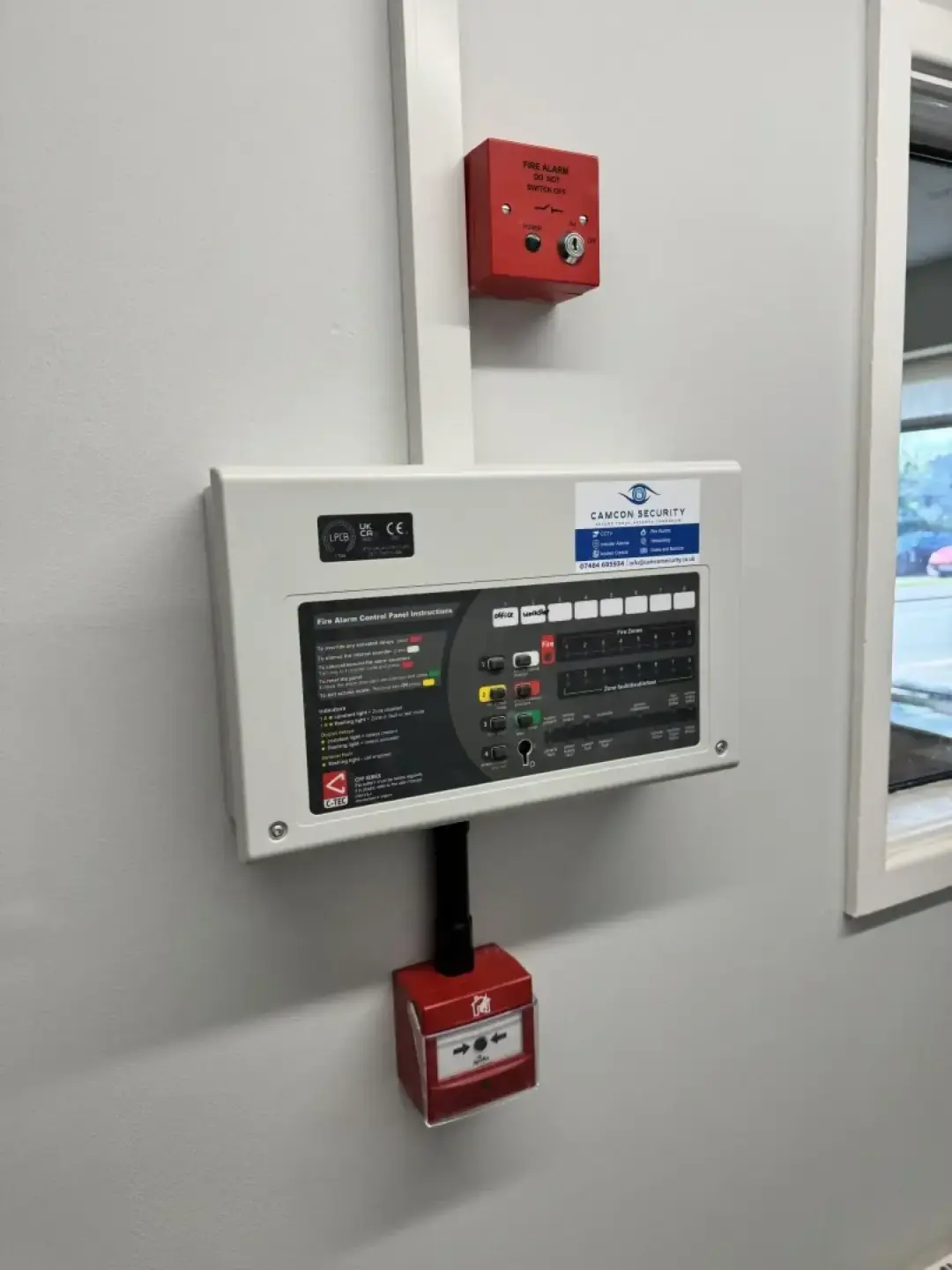
- The panel names the zone that activated, for whoever arrives.
- Detectors are chosen per room: heat in a kitchen, smoke elsewhere.
- Call points go on the escape routes, so a person can raise it.
- Sounders have to be audible over whatever the building is doing.
Zones are for the person who turns up
Zoning a building sounds like paperwork and is not. When the panel says the activation is in zone 3, whoever arrives walks to zone 3. When a building is wired as one zone, they search it.
For a small unit one or two zones is often right. For anything with separate floors, a back workshop, or a tenanted part of the building, the zones should follow how a person would actually move through it rather than how the cable happened to run.
An installed system and a commissioned system are not the same thing. Commissioning means every device has been tested and the result written down, and that record is what turns a collection of equipment into something you can show an inspector or an insurer.
The log book
- Weekly call point tests, written down as you do them.
- Every service visit, with what was found and what changed.
- It is the evidence afterwards that the system was looked after.
Commissioning, servicing and takeovers
It is also the part most often missing on systems we take over. We are regularly called to premises in Lowestoft and Beccles where the equipment is perfectly sound and there is no commissioning record and no log book, which means the building cannot demonstrate anything about it at all.
A fire alarm needs servicing on an ongoing basis and the log book needs to stay current. We service systems other companies installed as readily as our own, and where a system is sound we would rather service it than sell you a replacement.
If you are also fitting intruder alarms or cameras, doing them together means one set of cable runs and one engineer who knows the whole building, rather than three firms each pointing at the others when something stops working, which is how we usually do it alongside a burglar alarm installation.
Talk to us about your premises
Send us the risk assessment and we will tell you what the building needs.