
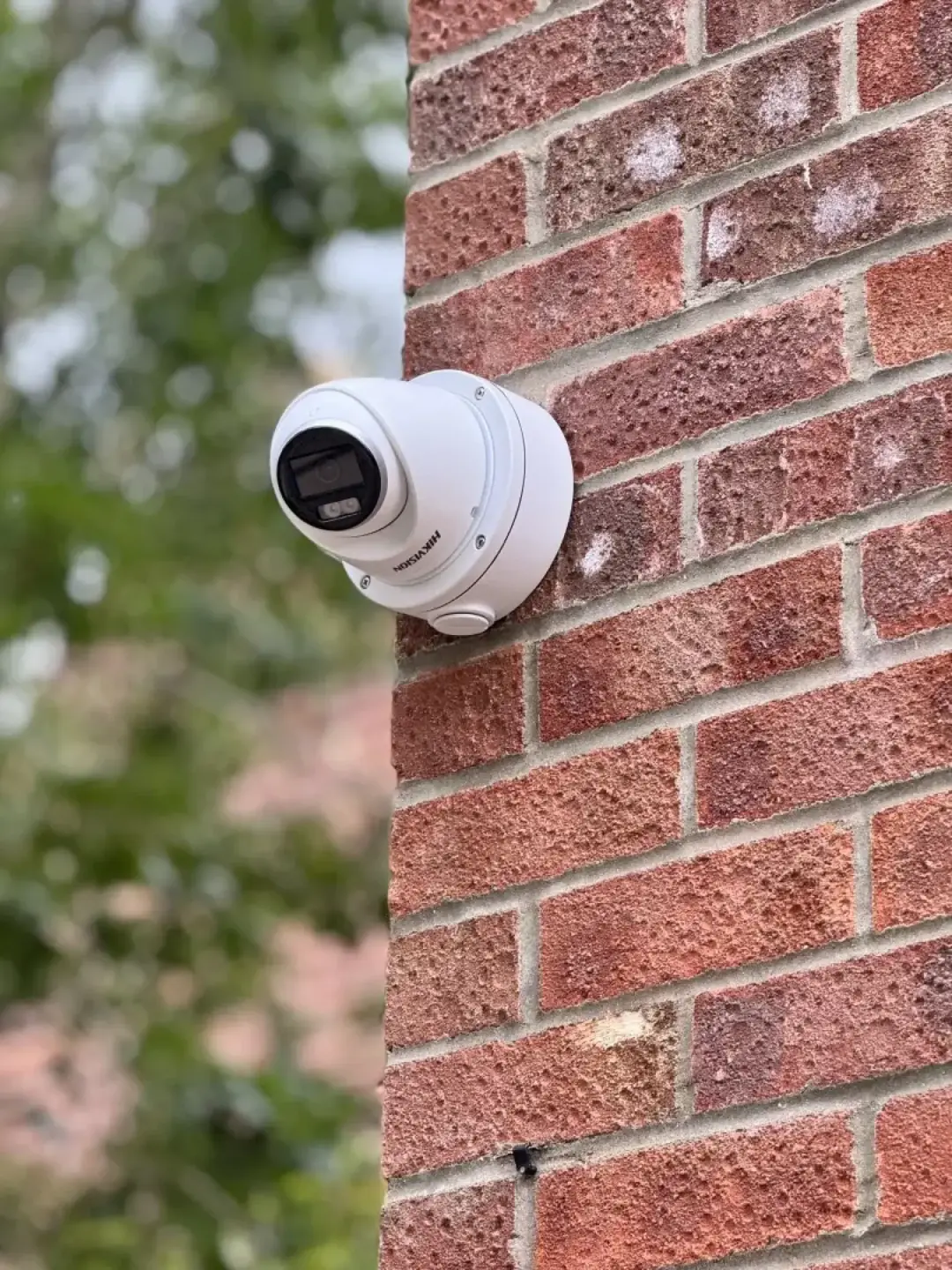
Good CCTV camera placement starts with one rule: put the camera at head height on the path somebody has to walk, pointing back along it. Not up on the corner of the house looking down. A camera eight feet up gives you the top of a hood and a pair of shoulders, which tells you that somebody came, and nothing at all about who.
The one camera that identifies, and the rest that tell the story
A system does two different jobs and people usually buy only the second one. Most cameras are there to show what happened: somebody crossed the yard, went to the shed, left by the gate. One camera has to do something harder, which is produce a face or a number plate good enough to be worth handing to anybody.
That camera is the one you site first, and you site it where the person has no choice. On a house that is usually the front door approach, because whoever is coming in has to arrive at the door. On a yard in Lowestoft or Beccles it is the gate, because the gate is the pinch point whatever they do afterwards.
Getting that one right is worth more than adding two more cameras. We would rather fit four cameras where one of them genuinely identifies than eight that all show the same anonymous figure from different angles.
Head height, and facing the way they come
Mount it at about the height of a person's face, between six and seven feet, and point it along the direction of travel rather than across it. A face passing left to right is in frame for a fraction of a second. A face walking towards the lens is in frame for several steps, which is several chances for one usable frame.
Six or seven feet feels low to people who expect a camera out of reach. It is low enough to interfere with, which is the trade: a camera nobody can reach is also a camera that never sees a face. In practice the answer is both, a high camera watching the area and a low one on the approach, which is why a useful domestic system is rarely one camera.
How close is close enough
Identification is a question of how much of the frame a face fills, not how many megapixels the camera has. A high resolution camera covering a whole car park spreads its pixels across the car park; the face in the corner of it gets very few of them either way.
The practical test on a survey is simple and you can do it yourself. Stand where you expect somebody to be and look at the live view. If you cannot tell who you are looking at on the screen, the recording will not be better than the live view, and no amount of zooming afterwards invents detail that was never captured.
This is the single most common disappointment with a system somebody bought in a box. The cameras are fine. They are covering too much ground each.
The things that ruin a good position
Three things spoil more camera positions than anything else, and all three are visible on a survey before anything is fitted.
- The sun. A camera pointing roughly east or west spends part of every clear day looking into glare. The picture at nine in the morning is not the picture at four in the afternoon, and a position that looks perfect on a grey day in January can be unusable in June.
- A light behind the subject. A porch light or a security lamp behind somebody turns them into a silhouette. The fix is usually moving the camera a few feet, not buying a better one.
- Something that moves. A branch, a flag, a washing line. On motion recording it fills the drive and, worse, trains everybody in the building to ignore alerts.
Doorbell cameras, and what they are good for
A video doorbell is genuinely good at one thing: the person who comes to the door and presses it. It is at the right height, they are facing it, and they have stopped moving.
What it is not is a substitute for a camera covering the approach. It sees a narrow cone directly in front of the door, usually from slightly below, and anybody who walks past the door rather than up to it is either out of frame or crossing it. Treat it as a useful extra on the door, not as the camera that covers the front of the building.
What changes on a business site
On commercial premises the identifying camera usually goes on the pedestrian route rather than the vehicle one, because people get out of vehicles and walk. Number plates want their own camera, square on to the traffic and far enough back that the plate is not moving across the frame.
Covered areas are worth thinking about separately. A loading bay or a covered yard is dark in the middle of the day, and a camera set for the bright approach will lose everything under the canopy. That is usually a second camera rather than a cleverer one.
If there is already an access control system or an intruder alarm on the building, the cameras should sit on the same network and the same app rather than becoming a second system to check. We fit both, which is usually why we end up moving somebody's existing cameras rather than adding to them.
How we decide CCTV camera placement on a survey
We walk the route an intruder would walk, not the boundary. Where you run out of choices about where to put your feet, that is where the camera goes. On most houses there are two or three such points and they are usually obvious once you are standing in them, which is why we would rather come and look than quote from a satellite picture.
Then we check each position against the three spoilers above, and against where the cable can actually run, because a perfect position the cable cannot reach is not a position. It takes about twenty minutes on a domestic property and rather longer on a yard.